
Independent guidance for confident surgical decisions
Surgical Advisor
Home About Us
Blog Contact Us Get Surgical Guidance
Surgical Advisor Treatment

Nephrectomy

Uro Surgery

Looking for a Nephrectomy Specialist in Mumbai?

A medical advisory service can help connect patients with experienced urologists, uro-oncology specialists, and robotic urological surgeons in Mumbai.

Nephrectomy

Nephrectomy is a surgical procedure in which part or all of a kidney is removed. It may be required for kidney cancer, a severely damaged or non-functioning kidney, certain congenital abnormalities, serious infections, or kidney donation.

Need help understanding this treatment?

Discuss your questions with
our Mumbai advisory team.

Treatment Information

Understanding Nephrectomy

Types of nephrectomy include:

Partial Nephrectomy

Only the diseased portion of the kidney is removed while preserving healthy tissue.

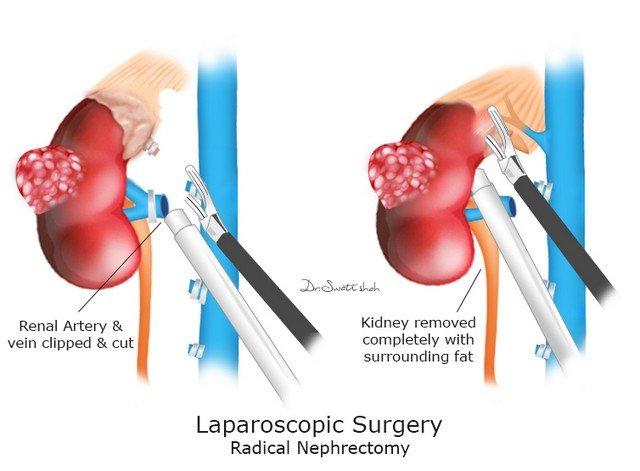
Radical Nephrectomy

The entire kidney is removed and, depending on the condition, nearby tissue may also be removed.

Simple Nephrectomy

The kidney is removed for non-cancerous conditions when it is severely damaged or non-functioning.

Surgery may be performed using:

  1. Open surgery
  2. Laparoscopic surgery
  3. Robotic-assisted surgery


BEFORE SURGERY

Pre-Care

Patients may require:

  1. CT or MRI scans
  2. Kidney function tests
  3. Blood tests
  4. Anaesthesia assessment
  5. Medication review
  6. Fasting before surgery


AFTER SURGERY

Post-Care

Patients should:

  1. Take medicines as directed.
  2. Walk gradually.
  3. Keep incisions clean.
  4. Avoid heavy lifting initially.
  5. Maintain hydration.
  6. Attend kidney function follow-ups.

Seek medical attention for fever, worsening pain, wound discharge, reduced urine output, chest pain, or shortness of breath.

Common Questions

Questions patients
often want clarified.

These answers provide general guidance. Your treating specialist should assess your individual condition and medical requirements.

Can a person live with one kidney?
Yes. Many people live normally with one healthy kidney.
Why is partial nephrectomy preferred when possible?
It preserves more functioning kidney tissue.
How long does surgery take?
The duration varies based on the procedure and complexity.
Will kidney function be monitored afterward?
Yes. Blood pressure and kidney function are generally monitored.
What are the risks?
Possible risks include bleeding, infection, urine leakage, blood clots, and injury to nearby structures.
Doctor discussing surgical treatment with patient
Independent Surgical Guidance

A clearer conversation
can change what comes next.

Understand the questions worth asking before your next consultation.
