
Independent guidance for confident surgical decisions
Surgical Advisor
Home About Us
Blog Contact Us Get Surgical Guidance
Surgical Advisor Treatment

HoLEP / Laser Prostate Surgery

Uro Surgery

Looking for a HoLEP Specialist in Mumbai?

A medical advisory service can help connect patients with experienced laser prostate and endourology specialists in Mumbai.

HoLEP / Laser Prostate Surgery

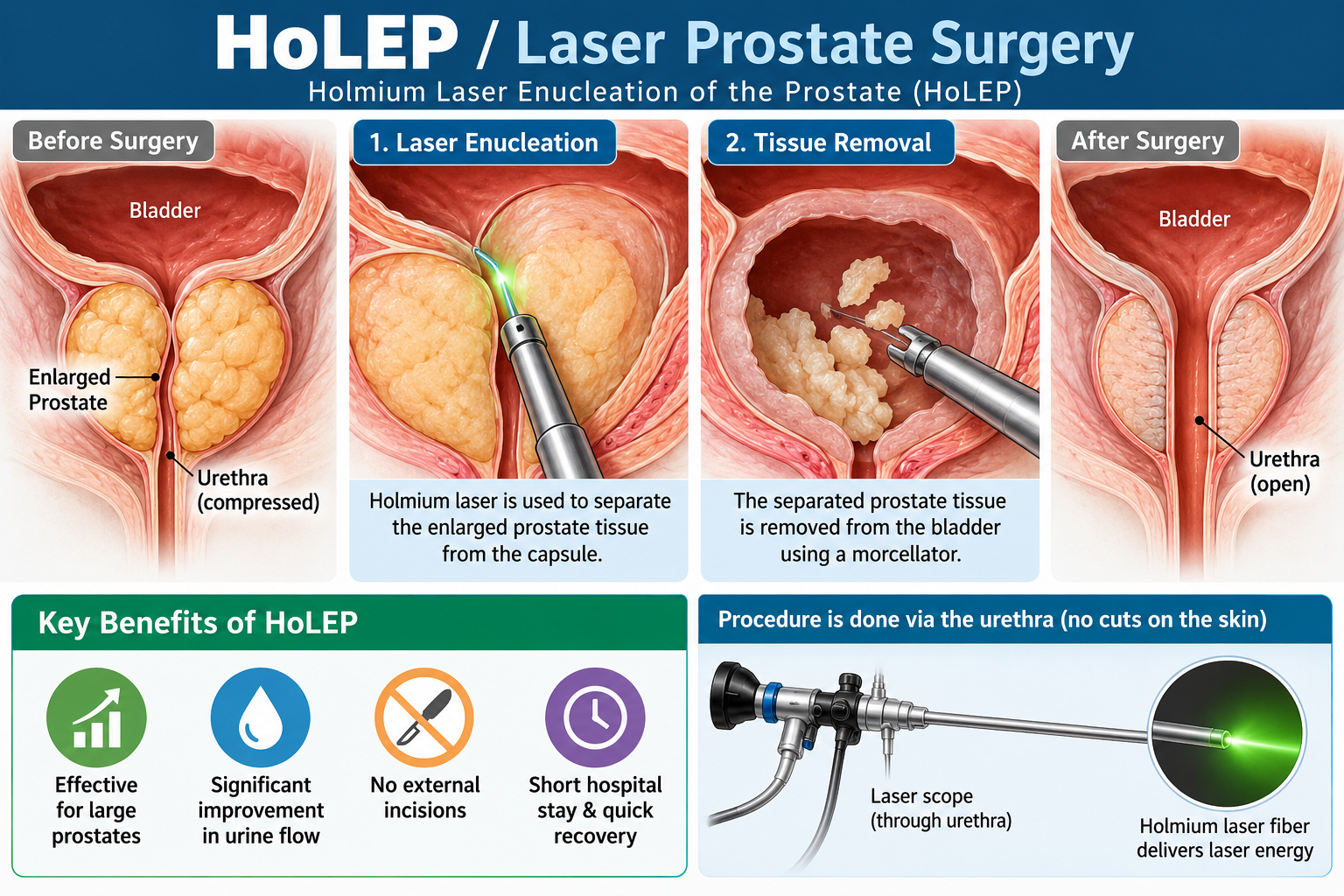
Holmium Laser Enucleation of the Prostate (HoLEP) is a minimally invasive laser procedure used to treat urinary obstruction caused by an enlarged prostate. It removes obstructing prostate tissue through the urethra and can be suitable for a wide range of prostate sizes.

Need help understanding this treatment?

Discuss your questions with
our Mumbai advisory team.

Treatment Information

Understanding HoLEP / Laser Prostate Surgery

During HoLEP:

  1. A scope is inserted through the urethra.
  2. Laser energy separates enlarged prostate tissue.
  3. The tissue is removed from the bladder using specialised equipment.
  4. A catheter is temporarily placed.

Advantages in selected patients may include effective removal of obstructing tissue and relatively low blood loss.

BEFORE SURGERY

Pre-Care

Evaluation may include:

  1. PSA
  2. Urine tests
  3. Ultrasound
  4. Urinary flow testing
  5. Medication review
  6. Anaesthesia assessment
AFTER SURGERY

Post-Care

Patients should:

  1. Maintain hydration.
  2. Avoid heavy activity initially.
  3. Take prescribed medicines.
  4. Expect temporary burning or blood in urine.
  5. Attend follow-up for urinary flow and bladder function.
Common Questions

Questions patients
often want clarified.

These answers provide general guidance. Your treating specialist should assess your individual condition and medical requirements.

Is HoLEP suitable for large prostates?
It can be used for many large prostates, depending on the patient's condition.
Is there an external incision?
Usually no.
Will I need a catheter?
Usually for a short period.
Can ejaculation change?
Retrograde ejaculation commonly occurs.
What are the risks?
Possible risks include bleeding, infection, temporary urinary leakage, urethral narrowing, and urinary symptoms during recovery.
Doctor discussing surgical treatment with patient
Independent Surgical Guidance

A clearer conversation
can change what comes next.

Understand the questions worth asking before your next consultation.