
Independent guidance for confident surgical decisions
Surgical Advisor
Home About Us
Blog Contact Us Get Surgical Guidance
Surgical Advisor Treatment

Scar Revision Surgery

Plastic Surgery & Hair Transplant

Looking for Scar Revision Surgery in Mumbai?

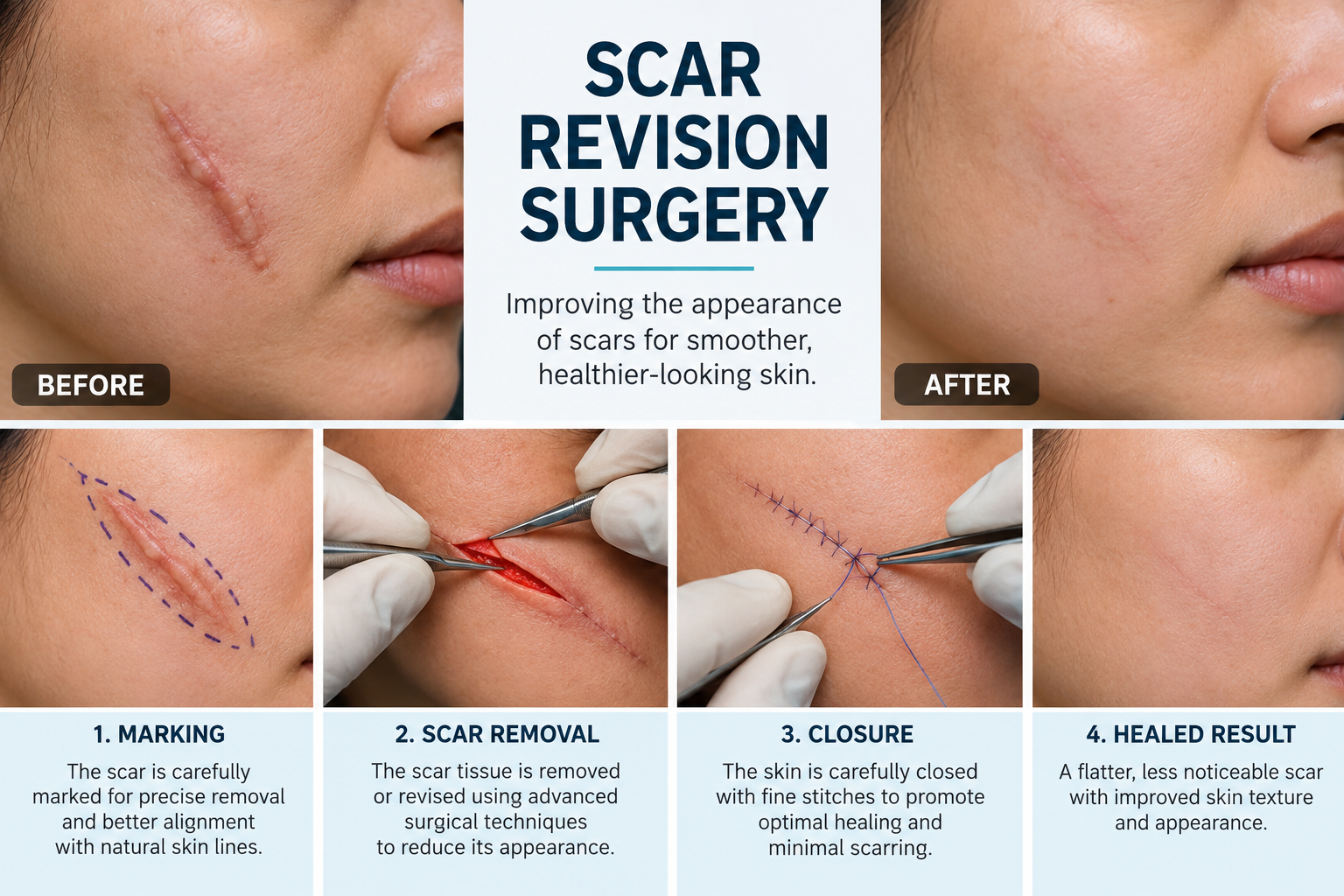
Scar revision surgery improves the appearance of prominent or irregular scars by reshaping, repositioning, or treating scar tissue to achieve a less noticeable appearance.

Scar Revision Surgery

Scar revision surgery is a procedure performed to improve the appearance, texture, position, or function of a scar. It may be considered for scars caused by injury, surgery, burns, acne, or other skin trauma. The goal is not always to remove a scar completely, but to make it less noticeable and improve the surrounding skin contour or movement where possible.

Need help understanding this treatment?

Discuss your questions with
our Mumbai advisory team.

Treatment Information

Understanding Scar Revision Surgery

Scars are a natural part of the healing process. Their appearance can vary depending on the type of injury, location on the body, skin type, genetics, wound care, and individual healing response.

Some scars may become raised, widened, depressed, irregular, discoloured, painful, itchy, or tight. In certain cases, scars can also restrict movement, especially when they develop near joints or after burns.

Scar revision surgery may be considered for:

  1. Wide or stretched scars
  2. Raised scars
  3. Depressed or sunken scars
  4. Irregular or poorly positioned scars
  5. Scars that cross natural skin lines
  6. Contracture scars that restrict movement
  7. Scars caused by surgery or trauma
  8. Burn scars
  9. Selected acne scars
  10. Scars that cause discomfort or functional problems

The choice of treatment depends on the type, size, depth, location, age, and characteristics of the scar.

Surgical Scar Revision

During surgical scar revision, the existing scar may be removed and the skin carefully closed again using techniques designed to create a finer or better-positioned scar.

Z-Plasty or W-Plasty

These techniques reposition or break up a straight scar so that it follows natural skin lines more closely. They may also help release tight scars or contractures.

Skin Grafting or Local Flaps

For larger or more complex scars, especially after burns or significant tissue loss, skin grafts or nearby tissue may be used to reconstruct the area.

Additional Treatments

Scar revision may sometimes be combined with non-surgical treatments such as:

  1. Steroid injections
  2. Silicone gel or sheets
  3. Laser treatment
  4. Microneedling
  5. Dermabrasion
  6. Pressure therapy
  7. Topical scar treatments

The procedure may be performed under local anaesthesia, sedation, or general anaesthesia depending on the size and complexity of the scar.

Scar revision does not usually make a scar disappear completely. The aim is to improve its appearance, texture, position, or function so that it becomes less noticeable or less restrictive.

BEFORE SURGERY

Pre-Care

Before scar revision, the surgeon will evaluate the scar, surrounding skin, medical history, and treatment goals.

Patients may be advised to:

  1. Inform the surgeon about all medical conditions and previous surgeries.
  2. Provide a complete list of medicines, vitamins, and supplements.
  3. Discuss aspirin, anticoagulants, and other blood-thinning medicines with the doctor.
  4. Do not stop prescribed medicines unless specifically instructed.
  5. Inform the surgeon about a history of keloids or abnormal scarring.
  6. Stop smoking or nicotine use before surgery if advised.
  7. Avoid alcohol for the period recommended before surgery.
  8. Protect the scar from excessive sun exposure.
  9. Follow instructions regarding skin preparation.
  10. Arrange transportation home if sedation or general anaesthesia is planned.
  11. Follow fasting instructions if required.
  12. Inform the doctor about any active skin infection, rash, or wound near the treatment area.


AFTER SURGERY

Post-Care

Proper aftercare can help support wound healing and improve the final scar appearance.

Patients should:

  1. Keep the surgical area clean and dry as instructed.
  2. Take prescribed medications exactly as directed.
  3. Avoid scratching, rubbing, or pulling on the incision.
  4. Avoid strenuous activity or stretching that places tension on the wound.
  5. Attend all scheduled follow-up appointments.
  6. Follow instructions regarding dressing changes and stitch removal.
  7. Use silicone gel or silicone sheets if recommended.
  8. Avoid smoking and nicotine during healing.
  9. Protect the healing scar from direct sunlight.
  10. Use sunscreen after the wound has healed and when advised by the surgeon.
  11. Avoid applying creams, oils, or cosmetic products to the wound unless approved.
  12. Follow any instructions regarding massage or pressure therapy.

Mild swelling, redness, tightness, itching, or tenderness may occur during early healing.

Contact the surgeon promptly if you experience increasing pain, excessive bleeding, significant swelling, fever, pus or foul-smelling discharge, wound separation, or rapidly worsening redness.

Scar healing can take several months. The final result depends on the type of scar, location, skin type, individual healing response, and the treatment method used. Patients should follow the personalised instructions provided by their plastic surgeon.

Common Questions

Questions patients
often want clarified.

These answers provide general guidance. Your treating specialist should assess your individual condition and medical requirements.

Can scar revision completely remove a scar?
No. Scar revision usually cannot remove a scar completely. The goal is to make the scar less noticeable and improve its appearance or function.
What types of scars can be treated?
Scar revision may be used for widened, raised, depressed, irregular, contracture, traumatic, surgical, burn-related, and selected acne scars.
When should scar revision be performed?
Many scars continue to mature for several months after an injury or surgery. In some cases, doctors may recommend waiting until the scar has matured before performing revision, unless there is a functional problem that requires earlier treatment.
Is scar revision surgery painful?
The procedure is usually performed under local anaesthesia, sedation, or general anaesthesia. Mild soreness, tightness, or tenderness may occur during recovery.
How long does scar revision surgery take?
The duration depends on the size and complexity of the scar. Small revisions may take less than an hour, while more extensive procedures may take longer.
How long does recovery take?
Recovery varies according to the procedure. Many patients can resume light activities within a few days, while larger revisions may require several weeks of healing.
Will the new scar look better immediately?
The new scar may initially appear red, swollen, or raised. Scar maturation is gradual, and the final appearance can take several months to develop.
Can scars come back after revision?
Some scars, particularly hypertrophic or keloid scars, may recur. Additional treatments such as steroid injections, silicone therapy, or other measures may be recommended to reduce this risk.
What are the possible risks of scar revision?
Possible risks include bleeding, infection, delayed wound healing, widened scars, pigmentation changes, numbness, asymmetry, recurrence, and dissatisfaction with the appearance.
Doctor discussing surgical treatment with patient
Independent Surgical Guidance

A clearer conversation
can change what comes next.

Understand the questions worth asking before your next consultation.