
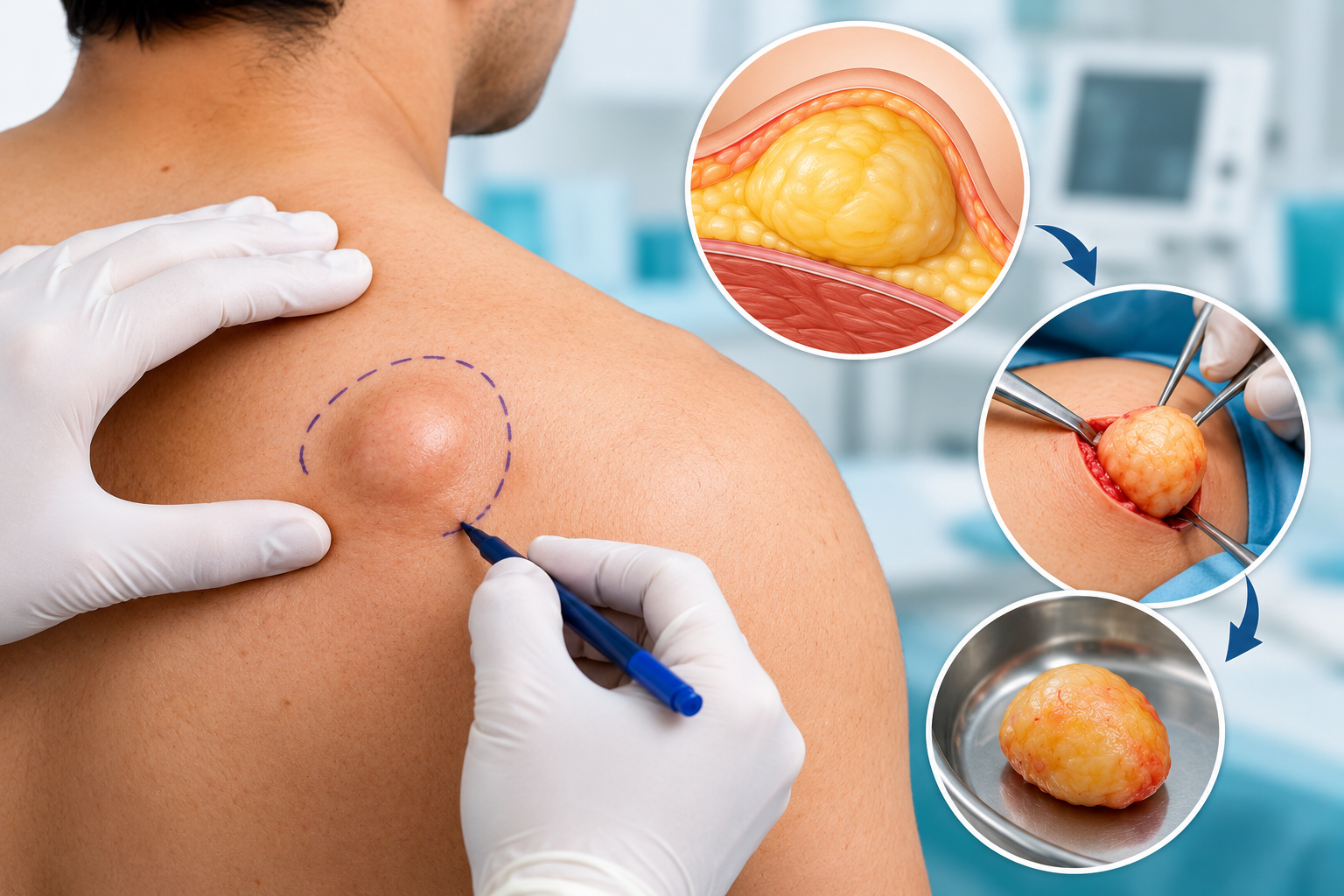
Lipoma removal surgery is a minor surgical procedure performed to remove a lipoma, which is a soft, non-cancerous lump made up of fatty tissue. Lipomas are usually painless and slow-growing, but removal may be considered if the lump becomes painful, increases in size, causes pressure or discomfort, affects movement, or creates cosmetic concerns.
A lipoma is a benign growth of fat cells that usually develops just beneath the skin. It commonly feels soft, rubbery, and movable when touched.
Lipomas can occur almost anywhere on the body, but they are frequently found on areas such as:
- Neck
- Shoulders
- Back
- Arms
- Thighs
- Abdomen
- Chest
- Forehead or scalp in selected cases
Most lipomas are harmless and do not require treatment. However, removal may be recommended when the lipoma:
- Becomes painful or tender
- Continues to grow
- Causes pressure on nearby structures
- Restricts movement
- Frequently rubs against clothing
- Causes noticeable swelling or asymmetry
- Creates cosmetic concerns
- Has unusual features that require further evaluation
Surgical Excision
Surgical excision is the most common method of lipoma removal.
During the procedure, the surgeon makes an incision over or near the lipoma and carefully removes the fatty lump, usually along with its surrounding capsule.
The incision is then closed with stitches.
Liposuction-Assisted Removal
In selected cases, particularly for certain larger or softer lipomas, liposuction may be used to reduce the size of the fatty mass.
However, this technique may not always remove the entire capsule, which can influence the risk of recurrence.
Diagnostic Examination
If a lump has unusual characteristics, the doctor may recommend imaging or other tests before surgery.
The removed tissue may also be sent for laboratory examination to confirm the diagnosis.
Lipoma removal is often performed under local anaesthesia for smaller and superficial lipomas. Larger, deeper, or multiple lipomas may require sedation or general anaesthesia.
Recovery is generally straightforward, although the exact healing period depends on the size, location, and depth of the lipoma.
