
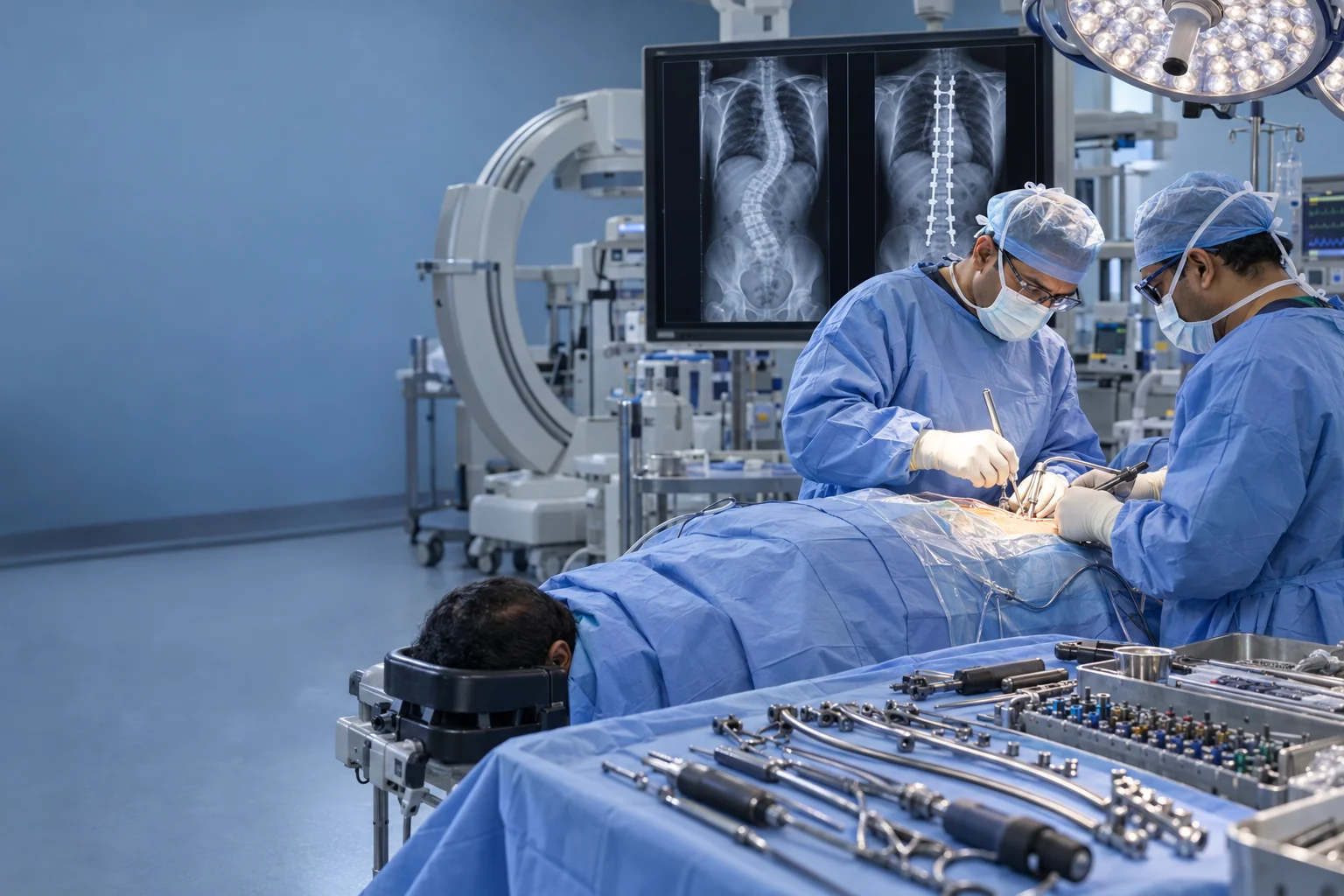
Scoliosis correction refers to surgical treatment for an abnormal sideways curvature and rotation of the spine. Surgery may be considered when scoliosis is severe, continues to progress, causes significant imbalance or symptoms, or is likely to worsen despite non-surgical treatment. The aim is generally to prevent further progression, improve spinal alignment and balance, and maintain as much safe function as possible.
Scoliosis is a condition in which the spine curves sideways and may also rotate. It can affect children, adolescents, or adults and may involve the upper back, lower back, or both.
Scoliosis can have different causes, including:
- Adolescent idiopathic scoliosis
- Congenital scoliosis
- Neuromuscular conditions
- Degenerative changes in adults
- Early-onset scoliosis
- Certain neurological or muscular disorders
Some people with scoliosis have only a mild curve and require regular monitoring. Others may require physiotherapy or bracing, particularly while they are still growing.
Surgery is usually reserved for selected patients with significant or progressive spinal deformity.
Symptoms or concerns associated with more significant scoliosis may include:
- Visible curvature of the spine
- Uneven shoulders
- Uneven waist or hips
- Rib prominence
- Leaning to one side
- Back discomfort
- Reduced spinal balance
- Nerve-related symptoms in some adults
- Difficulty with daily activities in severe cases
- Breathing difficulties in some very severe curves
When Is Scoliosis Correction Surgery Considered?
Surgery may be considered when:
- The spinal curve is severe
- The curve continues to progress
- Bracing or observation is no longer sufficient
- Spinal imbalance significantly affects posture or function
- Persistent pain or nerve compression affects daily life in adults
- The deformity is expected to continue worsening
- Severe curvature affects other body functions in selected cases
The decision is based on several factors, including the patient's age, skeletal maturity, curve size and location, progression, symptoms, overall health, and underlying cause.
Spinal Fusion for Scoliosis
Spinal fusion with instrumentation is one of the most commonly used operations for significant scoliosis.
During surgery, the surgeon carefully realigns the spine and places specialised implants such as:
- Pedicle screws
- Rods
- Hooks in selected cases
- Other fixation devices
Bone graft material is placed along the selected vertebrae so that they gradually heal together into a solid fusion.
The implants help maintain the corrected spinal position while fusion takes place.
The goal is generally not to make the spine perfectly straight but to achieve a safe correction while improving balance and preventing further progression.
Osteotomy and Complex Deformity Correction
For severe or rigid spinal deformities, the surgeon may need to perform an osteotomy.
An osteotomy involves carefully cutting and reshaping part of the spinal bone to allow greater correction.
These procedures are generally reserved for complex cases and require specialised spine-deformity expertise.
Growing Children
Treatment can be different in young children who still have significant growth remaining.
In selected cases, growth-friendly techniques may be considered to help control the spinal curve while allowing continued growth of the spine and chest.
The appropriate treatment depends heavily on the child's age, type of scoliosis, and expected growth.
