
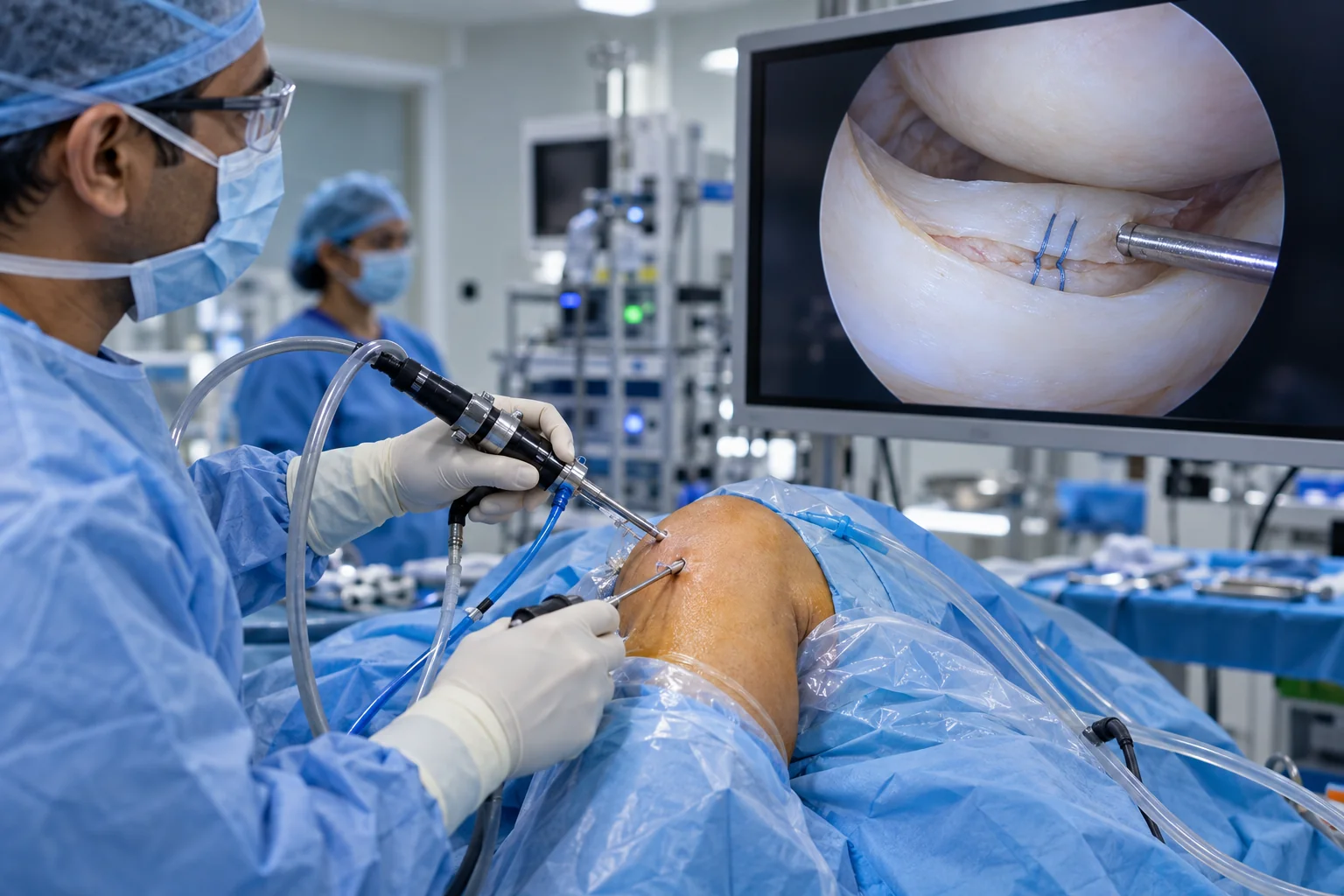
Meniscal repair is an orthopaedic procedure used to treat a torn meniscus in the knee. The meniscus is a C-shaped piece of cartilage that acts as a shock absorber between the thigh bone and shin bone. Repair may be recommended when the tear is suitable for healing and causes symptoms such as pain, swelling, locking, or instability.
Each knee contains two menisci: the medial meniscus on the inner side of the knee and the lateral meniscus on the outer side.
The menisci help:
- Absorb shock
- Distribute body weight across the knee
- Improve joint stability
- Protect the cartilage covering the knee joint
A meniscus can tear because of a sudden twisting injury or gradual degeneration over time.
Common causes include:
- Sports involving twisting or pivoting
- Sudden changes in direction
- Deep squatting
- Falls
- Road traffic accidents
- Age-related degeneration
- Injuries associated with ACL tears
Symptoms of a meniscus tear may include:
- Pain along the joint line
- Swelling
- Clicking or catching
- Difficulty fully bending or straightening the knee
- A locking sensation
- Knee stiffness
- Feeling that the knee may give way
When Is Meniscal Repair Considered?
Not every meniscus tear requires surgery.
Some small or degenerative tears may improve with:
- Rest
- Activity modification
- Physiotherapy
- Anti-inflammatory medication
- Strengthening exercises
Surgery may be considered when:
- Symptoms persist despite non-surgical treatment
- The knee repeatedly locks or catches
- The tear is unstable
- The patient is young or physically active
- The tear is located in an area with better blood supply
- The injury occurs together with an ACL tear
- Preserving the meniscus is considered beneficial for long-term knee health
Arthroscopic Meniscal Repair
Meniscal repair is usually performed arthroscopically.
The surgeon makes small incisions around the knee and inserts a small camera called an arthroscope.
The torn edges of the meniscus are prepared and repaired using specialised sutures, anchors, or fixation devices.
The goal is to preserve as much healthy meniscal tissue as possible.
Meniscectomy vs Meniscal Repair
In some cases, the meniscus cannot be repaired because of the tear pattern, location, tissue quality, or extent of damage.
In such cases, the surgeon may perform a partial meniscectomy, which removes only the damaged part of the meniscus.
Whenever possible, preserving and repairing the meniscus is often preferred because the meniscus plays an important role in protecting the knee joint.
