
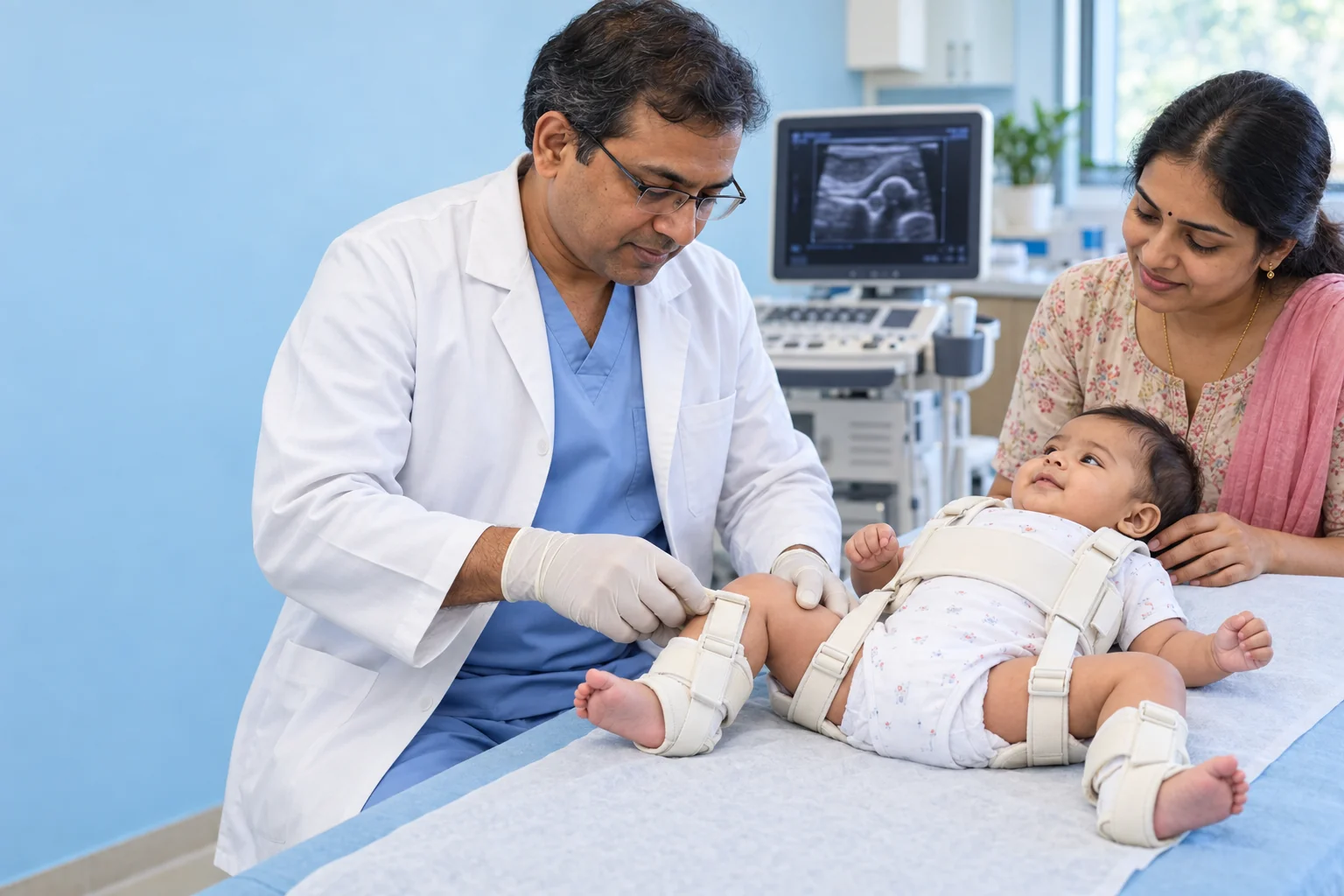
Developmental Dysplasia of the Hip, commonly called DDH, is a condition in which the hip joint does not develop normally in babies or young children. The hip socket may be too shallow, and the head of the thigh bone may be loose, partially displaced, or completely dislocated. Early diagnosis and treatment are important because timely correction can support more normal hip development and reduce the risk of future joint problems.
The hip is a ball-and-socket joint. The rounded head of the femur fits into a cup-shaped socket in the pelvis called the acetabulum.
In Developmental Dysplasia of the Hip, this relationship is abnormal. The socket may be too shallow or the femoral head may not sit securely in the joint.
DDH can range from mild looseness to complete dislocation.
It may affect one hip or both hips.
Risk factors can include:
- Family history of DDH
- Breech position during pregnancy
- Female sex
- First pregnancy
- Reduced space in the womb
- Certain foot or neck positioning conditions
- Tight swaddling with the hips held straight
However, DDH can also occur without any obvious risk factor.
Symptoms and Signs
In newborns, DDH may not cause obvious symptoms.
Doctors may notice signs such as:
- Hip instability during examination
- Limited movement of one hip
- Uneven skin folds around the thighs or buttocks
- One leg appearing shorter
- Difference in leg position
In older infants or children, signs may include:
- Delayed walking
- Limping
- Waddling gait
- Walking on the toes of one foot
- Uneven leg length
- Reduced hip movement
Diagnosis
Diagnosis may involve:
- Physical examination
- Ultrasound of the hip in young infants
- X-rays in older babies and children
The appropriate imaging method depends on the child's age and hip development.
Pavlik Harness
In young babies, DDH is often treated with a soft positioning device called a Pavlik harness.
The harness holds the hips in a flexed and appropriately positioned posture, helping the femoral head remain within the socket while the joint develops.
Regular monitoring is necessary to ensure the hip remains in the correct position.
Closed Reduction
If the hip cannot be corrected with a harness or if the child is diagnosed later, a closed reduction may be considered.
Under anaesthesia, the surgeon gently places the femoral head back into the hip socket without making a large surgical incision.
A hip spica cast is usually applied afterward to maintain the corrected position.
Open Reduction
If closed reduction is unsuccessful or not appropriate, open surgery may be required.
The surgeon makes an incision to directly access the hip and remove any tissues preventing proper joint positioning.
The hip is then repositioned and usually protected with a spica cast.
Osteotomy
In older children or more complex cases, bone surgery called an osteotomy may be needed.
This may involve reshaping the pelvis or femur to improve hip alignment and stability.
The exact treatment depends on:
- Age at diagnosis
- Severity of dysplasia
- Whether the hip is dislocated
- Response to previous treatment
- Overall hip development
Early treatment usually provides a better opportunity for the hip to develop normally.
