
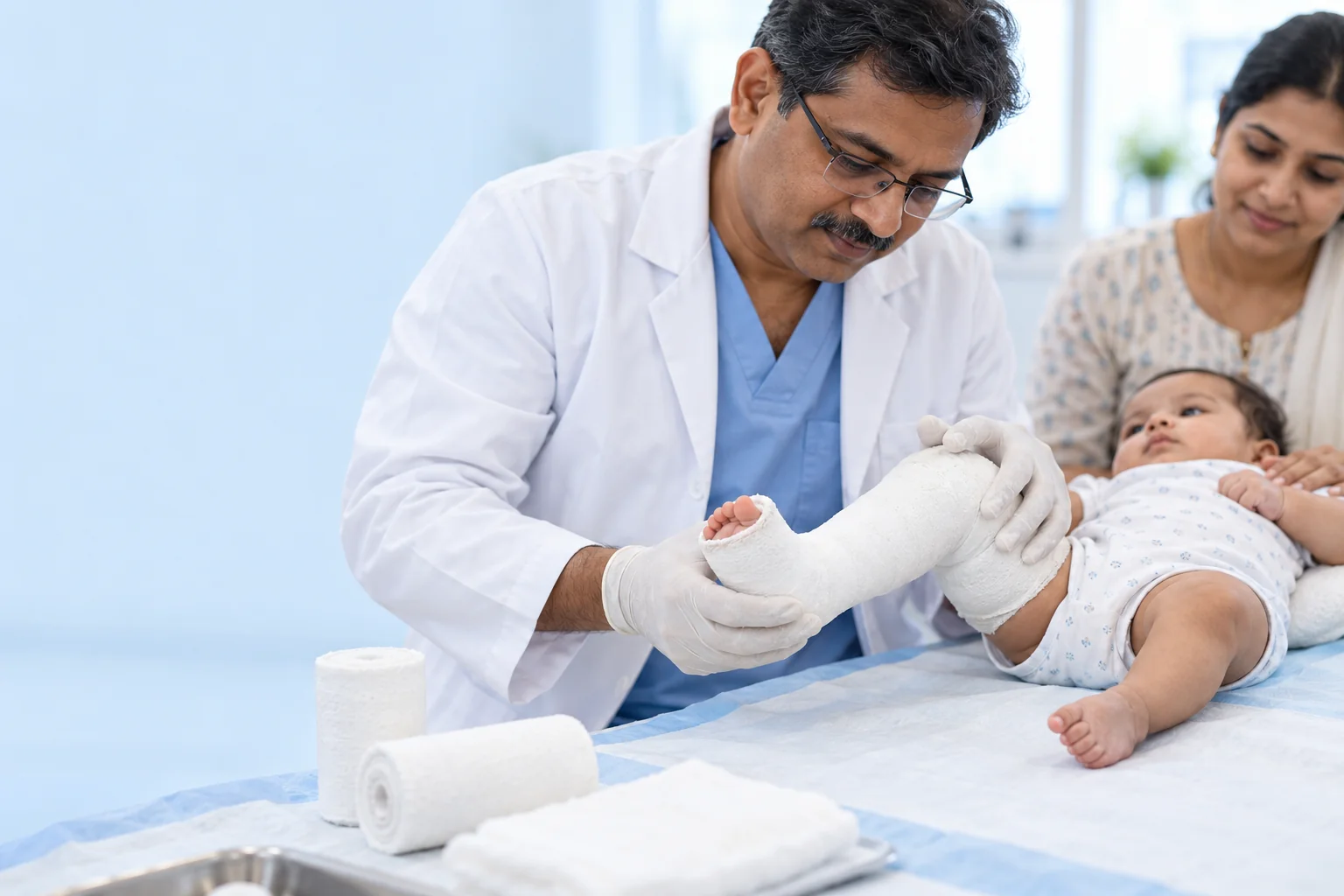
Clubfoot, medically known as congenital talipes equinovarus, is a condition in which one or both feet are turned inward and downward at birth. Treatment aims to gradually correct the position of the foot so that the child can develop a stable, flexible, and functional foot for standing and walking. Most babies are initially treated with non-surgical methods such as the Ponseti technique, while surgery may be considered in selected severe, resistant, or recurrent cases.
Clubfoot is a congenital condition that affects the bones, muscles, tendons, and ligaments of the foot and lower leg.
The affected foot may appear:
- Turned inward
- Pointed downward
- Smaller than the unaffected foot
- Stiffer than normal
- Associated with a tighter heel cord
- Accompanied by smaller calf muscles in some children
Clubfoot may affect one foot or both feet.
In many children, the exact cause is not known. In some cases, it can occur along with neurological, muscular, or other congenital conditions.
Early treatment is generally recommended because a baby's bones and soft tissues are more flexible during the first weeks and months of life.
Ponseti Method
The Ponseti method is commonly used as the first-line treatment for clubfoot.
Treatment usually involves:
- Gentle manipulation of the foot
- Application of a plaster cast
- Regular cast changes
- Gradual correction of the foot position
The casts are usually changed at regular intervals as the foot is progressively corrected.
Achilles Tenotomy
Many babies undergoing Ponseti treatment require a minor procedure called an Achilles tenotomy.
During this procedure, the tight Achilles tendon is released to allow the heel to move into a more normal position.
A cast is usually applied afterward while the tendon heals.
Bracing
After successful correction, the child usually needs to wear a specialised foot-abduction brace.
Bracing is an important part of treatment because clubfoot has a tendency to recur, especially during the early years of growth.
Parents need to follow the prescribed bracing schedule carefully.
Clubfoot Surgery
Most children can be treated successfully without major surgery.
Surgery may be considered when:
- The foot remains severely stiff
- Casting does not achieve adequate correction
- Clubfoot returns despite appropriate treatment
- The child presents late with untreated clubfoot
- There are complex or atypical deformities
- The condition is associated with neurological or other disorders
Surgery may involve releasing or lengthening tight tendons and ligaments, repositioning bones, or correcting residual deformity.
The exact procedure depends on the child's age, severity of the deformity, previous treatment, and overall condition.
