
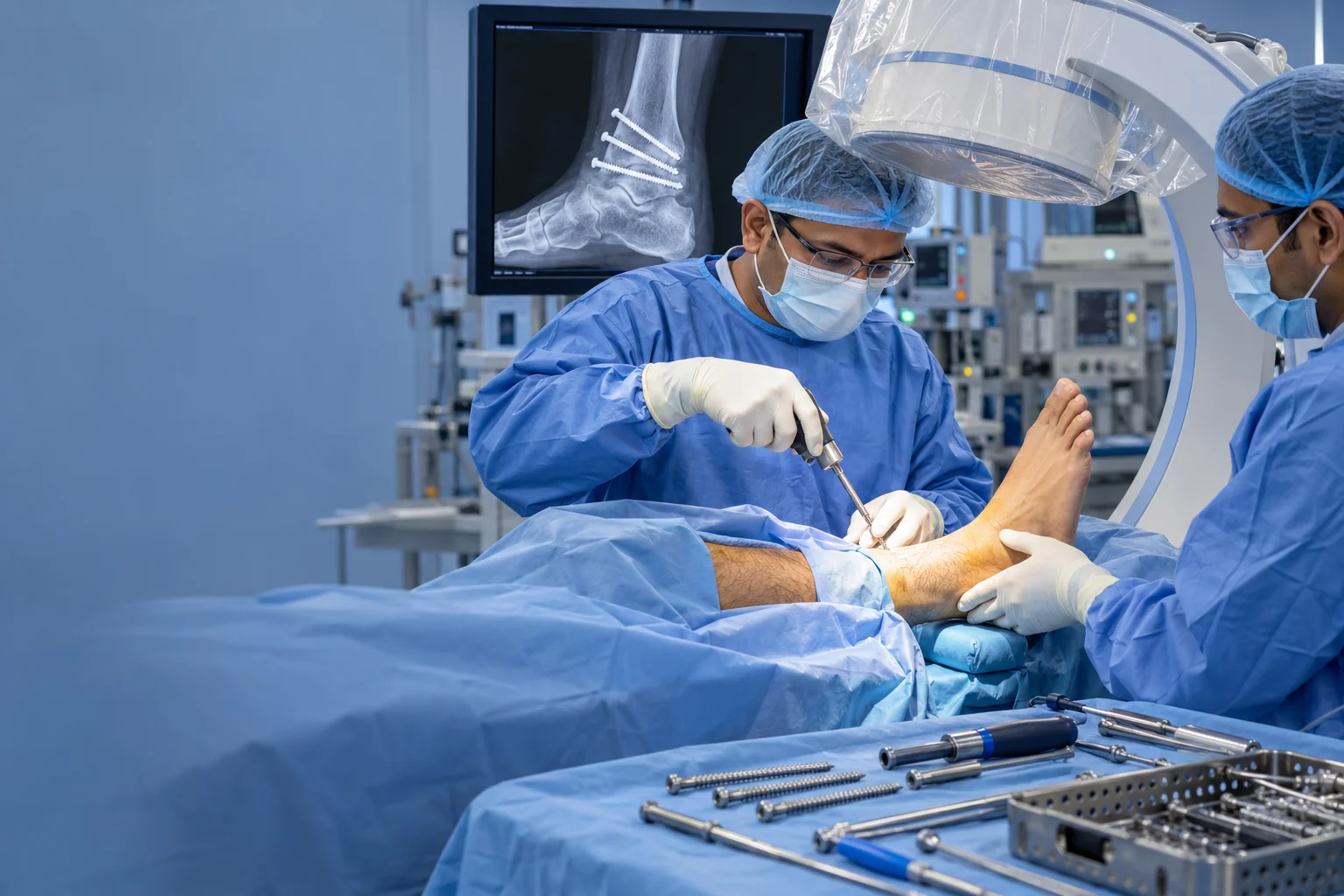
Ankle arthrodesis, commonly called ankle fusion, is a surgical procedure used to treat severe ankle arthritis or major joint damage. During the procedure, the damaged joint surfaces are removed and the bones forming the ankle joint are permanently joined together. The goal is to reduce pain and improve stability, although movement at the fused ankle joint is significantly reduced.
The ankle joint is formed mainly by the tibia, fibula, and talus. Healthy cartilage allows these bones to move smoothly.
When the cartilage becomes severely damaged because of arthritis, previous injury, infection, or another joint condition, movement can become painful.
Symptoms may include:
- Persistent ankle pain
- Swelling
- Stiffness
- Difficulty walking
- Reduced ability to stand for long periods
- Joint instability
- Deformity
- Pain during weight-bearing activities
Ankle fusion may be considered when non-surgical treatment no longer provides adequate relief.
Conditions That May Lead to Ankle Fusion
These include:
- Severe osteoarthritis
- Post-traumatic arthritis
- Rheumatoid arthritis
- Previous ankle fractures
- Severe ankle deformity
- Failed previous ankle surgery
- Certain infections after appropriate treatment
- Advanced joint degeneration
How Is Ankle Fusion Performed?
During surgery, the damaged cartilage is removed from the ankle joint surfaces.
The tibia and talus are positioned in appropriate alignment and held together using fixation devices such as:
- Screws
- Plates
- Rods in selected cases
Bone graft may sometimes be added to encourage the bones to heal together.
The procedure may be performed through open surgery or arthroscopically in selected patients.
Over time, the bones grow together and form a single solid unit.
Effect on Movement
Ankle fusion eliminates movement at the main ankle joint.
However, surrounding joints in the foot can continue to provide some movement, allowing many patients to walk and perform daily activities after recovery.
