
Independent guidance for confident surgical decisions
Surgical Advisor
Home About Us
Blog Contact Us Get Surgical Guidance
Surgical Advisor Treatment

ACL / PCL Reconstruction

Orthopedic Surgery

Looking for an ACL / PCL Reconstruction Specialist in Mumbai?

If you have a significant knee ligament injury, choosing the appropriate orthopaedic or sports-injury specialist is an important part of treatment planning. A medical advisory service can help you connect with experienced knee, arthroscopy, and sports-injury specialists in Mumbai based on your diagnosis, preferred location, activity level, consultation requirements, and treatment needs. A consultation with a qualified orthopaedic surgeon is necessary to determine whether physiotherapy alone may be sufficient or whether ACL, PCL, or multi-ligament reconstruction is appropriate.

ACL / PCL Reconstruction

ACL and PCL reconstruction are orthopaedic surgical procedures used to restore stability to the knee after a significant injury to the anterior cruciate ligament (ACL) or posterior cruciate ligament (PCL). These ligaments help control knee movement and stability. Reconstruction may be recommended when the ligament is completely torn, the knee remains unstable, or the patient wishes to return to demanding physical or sporting activities.

Need help understanding this treatment?

Discuss your questions with
our Mumbai advisory team.

Treatment Information

Understanding ACL / PCL Reconstruction

The ACL and PCL are two major ligaments located inside the knee joint.

The Anterior Cruciate Ligament (ACL) helps control forward movement and rotation of the shin bone, while the Posterior Cruciate Ligament (PCL) helps prevent excessive backward movement of the shin bone.

These ligaments can be injured during:

  1. Sports involving sudden direction changes
  2. Twisting or pivoting movements
  3. Sudden stops or awkward landings
  4. Road traffic accidents
  5. Direct impact to the knee
  6. Falls
  7. Contact sports

ACL Injury

ACL injuries commonly occur during activities involving twisting, pivoting, jumping, or sudden changes in direction.

Symptoms may include:

  1. A popping sensation at the time of injury
  2. Rapid swelling
  3. Knee pain
  4. Difficulty walking
  5. Feeling that the knee is giving way
  6. Reduced range of motion
  7. Instability during sports or physical activity

PCL Injury

PCL injuries are often caused by a strong impact to the front of a bent knee, such as during a road accident or sports injury.

Symptoms may include:

  1. Knee pain
  2. Swelling
  3. Difficulty walking
  4. A feeling of instability
  5. Reduced strength or confidence in the knee

When Is Reconstruction Required?

Not every ACL or PCL injury requires surgery.

Some partial tears or less active patients may be managed with physiotherapy, bracing, activity modification, and rehabilitation.

Reconstruction may be considered when:

  1. The ligament is completely torn
  2. The knee remains unstable despite rehabilitation
  3. The patient wants to return to competitive sports
  4. There are multiple ligament injuries
  5. The injury is associated with meniscus or cartilage damage
  6. Repeated episodes of knee giving way affect daily activities

ACL / PCL Reconstruction Procedure

During reconstruction, the damaged ligament is usually replaced with a graft rather than simply stitched together.

The graft may be taken from:

  1. Hamstring tendon
  2. Patellar tendon
  3. Quadriceps tendon
  4. Donor tissue in selected cases

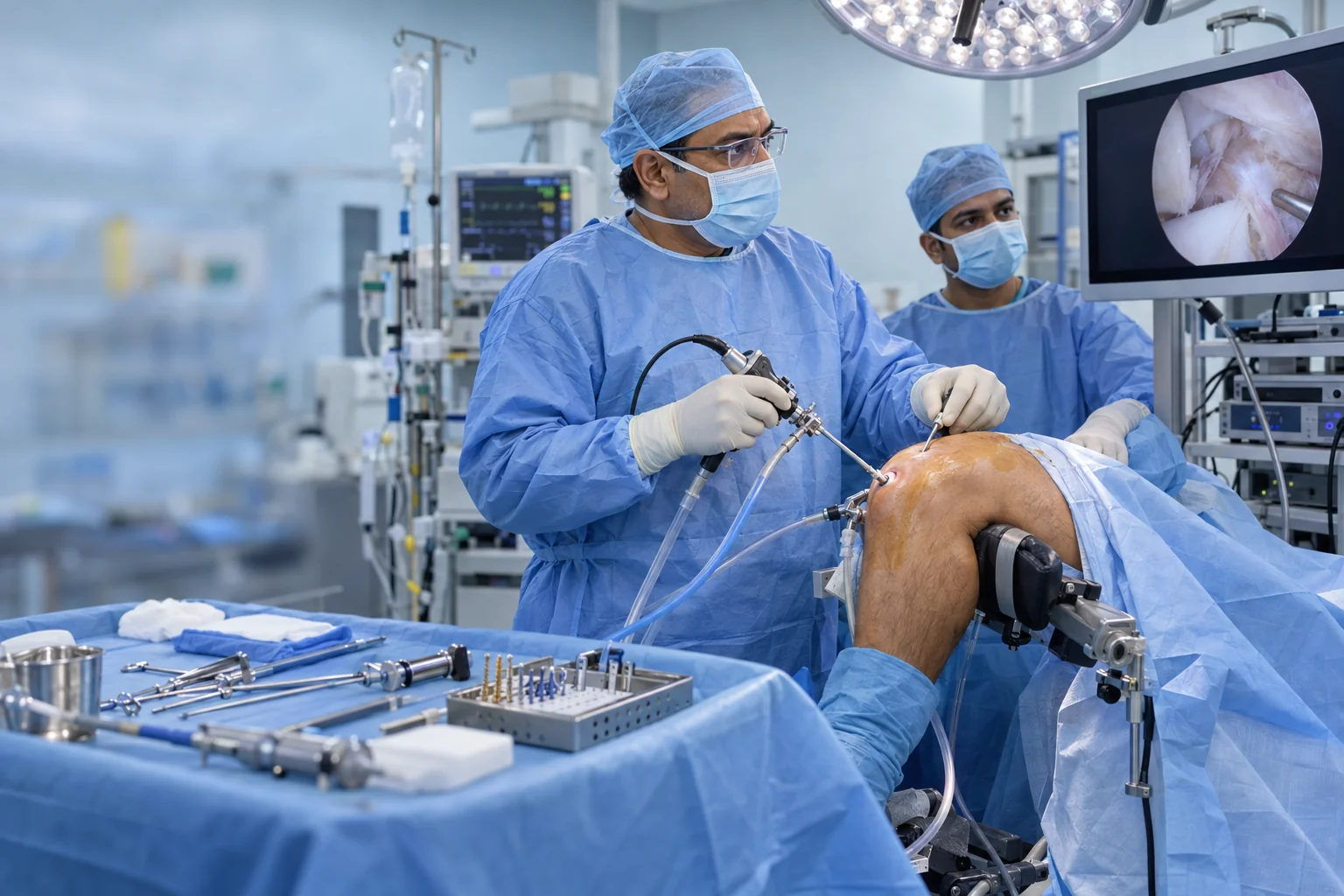
The procedure is usually performed arthroscopically using small incisions and a camera inserted into the knee.

The surgeon creates tunnels in the thigh bone and shin bone and positions the graft to reproduce the function of the damaged ligament. The graft is then secured using specialised fixation devices.

ACL reconstruction is more commonly performed than PCL reconstruction, while PCL surgery may be required for severe or combined ligament injuries.

BEFORE SURGERY

Pre-Care

Before surgery, the orthopaedic surgeon will evaluate the knee using a physical examination and imaging such as MRI or X-rays.

Patients may be advised to:

  1. Reduce swelling before surgery.
  2. Work on restoring knee movement before the procedure.
  3. Perform pre-operative physiotherapy if recommended.
  4. Strengthen the thigh muscles where possible.
  5. Inform the doctor about all medicines, supplements, and allergies.
  6. Discuss blood-thinning medicines with the medical team.
  7. Do not stop prescribed medicines unless specifically advised.
  8. Inform the surgeon about previous knee injuries or surgeries.
  9. Stop smoking and nicotine use before surgery if advised.
  10. Follow fasting instructions before anaesthesia.
  11. Arrange for someone to drive you home after discharge.
  12. Prepare crutches, a knee brace, or other aids if recommended.
  13. Arrange support at home during the early recovery period.

Reducing swelling and improving knee movement before surgery can help make rehabilitation easier afterward.

AFTER SURGERY

Post-Care

Rehabilitation is one of the most important parts of recovery after ligament reconstruction.

Patients should:

  1. Take prescribed pain medicines and other medications as directed.
  2. Use ice and elevation as advised to control swelling.
  3. Keep surgical wounds clean and dry.
  4. Use a knee brace if prescribed.
  5. Walk with crutches until the surgeon or physiotherapist advises otherwise.
  6. Begin physiotherapy at the recommended time.
  7. Perform prescribed range-of-motion exercises regularly.
  8. Gradually strengthen the thigh, hamstring, and surrounding muscles.
  9. Avoid running, jumping, twisting, and pivoting until medically cleared.
  10. Avoid returning to sports too early.
  11. Attend all scheduled follow-up appointments.
  12. Follow the surgeon's instructions regarding driving and work.

Some swelling, stiffness, bruising, and muscle weakness are common during the early recovery period.

Contact the surgeon promptly if you experience high fever, increasing redness, wound discharge, severe or worsening pain, sudden calf swelling, chest pain, shortness of breath, or sudden loss of movement.

Successful recovery depends not only on the surgery but also on consistent rehabilitation and gradual progression of activity.

Common Questions

Questions patients
often want clarified.

These answers provide general guidance. Your treating specialist should assess your individual condition and medical requirements.

What is the difference between an ACL and PCL injury?
Does every ACL or PCL tear require surgery?
No. Some ligament injuries can be managed successfully with physiotherapy and rehabilitation. Surgery is generally considered when instability persists or the patient has high physical demands.
Can a completely torn ACL heal on its own?
A completely torn ACL usually does not heal reliably enough to restore normal knee stability. Some patients can function without surgery through rehabilitation, while others may require reconstruction.
Is ACL reconstruction painful?
The procedure is performed under anaesthesia. Pain, swelling, and stiffness are expected after surgery but are usually managed with medication, ice, and physiotherapy.
How long does ACL / PCL reconstruction take?
The surgery typically takes around one to two hours, although the duration may be longer if other injuries are treated at the same time.
When can I walk after surgery?
Many patients begin walking with crutches and controlled weight-bearing soon after surgery. The exact timeline depends on the ligament reconstructed and any associated injuries.
How long does recovery take?
Recovery is gradual and usually takes several months. Return to running or sports generally requires a structured rehabilitation programme and medical clearance.
When can I return to sports?
Return to competitive or pivoting sports often takes around 9 to 12 months or longer, depending on strength, stability, graft healing, rehabilitation progress, and the surgeon's assessment.
Can ACL or PCL injuries occur again after reconstruction?
Yes. Re-injury or graft failure can occur, particularly with premature return to sports, another significant injury, or inadequate rehabilitation.
What are the possible risks of ACL / PCL reconstruction?
Possible risks include infection, bleeding, blood clots, knee stiffness, persistent instability, graft failure, numbness, pain at the graft-harvest site, reduced range of motion, and anaesthesia-related complications.
Doctor discussing surgical treatment with patient
Independent Surgical Guidance

A clearer conversation
can change what comes next.

Understand the questions worth asking before your next consultation.