
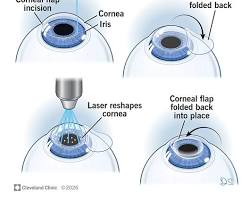
LASIK, or Laser-Assisted In Situ Keratomileusis, is a laser eye procedure used to correct common refractive errors such as nearsightedness, farsightedness, and astigmatism. The procedure reshapes the cornea so that light entering the eye can focus more accurately on the retina, helping reduce dependence on glasses or contact lenses.
LASIK surgery is a type of refractive eye surgery designed to improve vision by changing the shape of the cornea, which is the clear front surface of the eye.
In people with refractive errors, light does not focus correctly on the retina. This can result in blurred vision at different distances.
LASIK may be used to correct:
- Myopia (Nearsightedness): Distant objects appear blurred.
- Hyperopia (Farsightedness): Near objects may appear blurred.
- Astigmatism: Vision may appear blurred or distorted at both near and far distances.
During LASIK surgery, the ophthalmologist creates a thin flap on the surface of the cornea. A specialised excimer laser is then used to reshape the underlying corneal tissue according to the patient's refractive error. The corneal flap is repositioned after the laser correction and usually heals naturally without stitches.
The procedure is generally performed under topical anaesthetic eye drops and often takes only a few minutes per eye.
Many patients notice an improvement in vision within the first day or two, although vision may continue to stabilise over the following days or weeks.
LASIK is not suitable for everyone. Before surgery, a detailed eye evaluation is performed to assess factors such as corneal thickness, refractive stability, dry eye symptoms, pupil size, and overall eye health.
The expected outcome can vary depending on the patient's prescription, age, eye condition, and individual healing response.
